
Establishing Trust in Spatial Media: The XR Verification Badge
The merge between the physical and digital landscapes is happening at a faster pace than many institutions can keep up with, and lectures are now being recreated as three-dimensional spaces, while executive presentations are being transformed into spaces to explore. Book chapters are now accompanied by three-dimensional avatars of their authors. From the point at which your voice, face, and work appear in these spaces, questions regarding who gave their approval to the specific piece of work start to matter.
We deal with these issues daily. We are producing plus distributing innovative academic research and executive education materials as we request contributors to trust us with their names, images, representations, and findings. That trust must accompany the research, no matter where the research is being distributed.
Do We Still Need Verification Badges Today?
In the past, social media platforms have come up with a simple solution to ensure authenticity: putting a tiny blue check mark next to your name. The idea hasn’t aged gracefully in recent times. With the advent of verification as a paid subscription, media outlets such as The New York Times, The Guardian, Reuters, and The Atlantic have shown their resistance by refusing to pay for a symbol that is now just an indicator of an expense that needs to be incurred every month. Furthermore, research from Gizmodo suggested that having a check mark can make people more likely to spread false information, as the badge gives unwarranted authority to those ready to make the purchase.
The core issue is not just about one platform. Generative 3D tools can create a seemingly realistic likeness of famous public people in a matter of days. Voice cloning is done in minutes. The Brookings Institution has duly pointed out how the public’s ability to determine the truth in what they are shown has come under threat from this phenomenon. A survey done by the Pew Research Center in 2025 has revealed that 76% of Americans believe that it is crucial to distinguish between AI-created and human-made content, with most people not being sure that they can do it. Fox News has been tracking the FBI’s warnings about deepfake-enabled fraud, while The Wall Street Journal has explained how content credentials make the lives of photojournalists easier.
According to the MIT Technology Review, contemporary tagging solutions face the possibility of being easily erased or disregarded by their respective platforms. Scholarly articles agree with this sentiment; for example, a peer-reviewed article in Nature shows how quickly detection technologies fall behind the generative side of the conflict, while researchers from Harvard’s Digital Data Design Institute argue that forgiving edit history is the bare minimum for publishing companies to establish credibility. Research done by Stanford University’s Virtual Human Interaction Lab indicates that trust in a genuine piece of content diminishes after the audience has been tricked by a fake.
We are rapidly approaching that environment. Using an old blue tick will hardly be enough.
Designing the Seal: Where Heritage Meets the Future
The design of the badge illustrates that it occupies two worlds: that of the university archive and that of the headset.
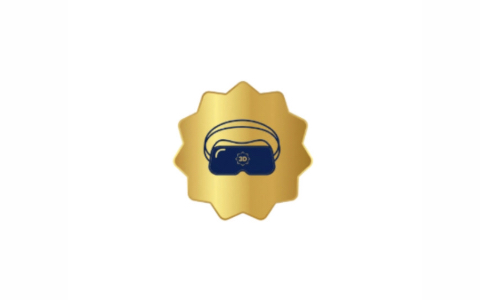
The round text consists of a golden serrated contour that recalls the traditional academic symbol used by educational institutions for ages to signify the authenticity of their documents. The innovation takes place at the center of the badge. Instead of the traditional coat of arms, we used a modern headset with a miniature 3D logo on it. This proves that the academic award underwent verification using the legendary methods and the new steps of modern technology.
The concept of heritage credibility, as applied to the media formats that both PwC and NVIDIA refer to as unprecedented breakthroughs in computer technology. When Fei-Fei Li claimed to the Financial Times that AI does not exist outside spatial observation, she referred to the very same future we are talking about. The scientists and businesspeople who appear on the horizon deserve to prove that they exist.
The Three Pillars of XR Verification
Before any asset on our site is awarded a badge, it must first undergo three rounds of review.
- Identity Provenance: The first human review process. This process allows us to check the identity of the host, author, or guest associated with the item; specifically, we check whether their name and image are still authorized in this form. Independent researchers mention that whenever an identity stamp is used in the XR field, it is necessary for an identity check to be multimodal, since any signal can be subject to imitation. We reach a mutual agreement, and therefore, our verification process operates in this way. Every contributor must approve having their images transformed, specifying which formats their avatar is cleared for, and that agreement travels with the asset.
- Spatial Fidelity. The technical component. Each 3D model, texture, and animation undergoes assessment for visual fidelity, performance of rendering, and evidence of any tampering. It uses the concept of reality authentication, which treats spatial layers similarly to the way HTTPS treats web pages: signed at origin, checked at delivery, and warned if modified. Our approach follows the standard established by C2PA, Adobe’s Content Authenticity Initiative; the NSA’s recommendations about Content Credentials; and the expansion of C2PA and SynthID, which was recently discussed by The Verge. Wired explains how these tokens become something like the de facto standard in AI-generated images, while Deloitte’s forecasts for the year 2025 present provenance signaling as an obligatory trust-inducing factor for businesses.
- Contextual Rigor: The academic aspect. The research, data, or story that is attached to the asset must undergo a quality check that any academic publication must pass through, which is something that social media platforms do not concern themselves with. As Forbes argues, the corporate blue tick implies decoration without any editorial value: our product can only be delivered with substantive value.
Where the Badge Lives on Our Platform
Here is the point where our badge transforms from being a policy document to becoming something tangible.
On our Authors page, the XR Verified badge is visible next to the eligible person’s name, and that means three steps were already completed: the registration of their identity, spatial assets validation, and approval of publishing record records.
Inside the XR Research Library, the featured profiles can be found at the beginning of a validated spatial lecture, an interactive briefing, or a 3D case. By clicking on the document, one can see who authored this piece, when its 3D elements were authorized, and what stage of review has been completed for it.
The mark is also utilized in our institutional partnerships. Whenever an academic institution, think tank, or corporate research team receives one of our spatial briefings for its own organization, they are also granted the XR Verified mark. This indicates to the audience that the avatar, as well as the reference research, was reviewed thoroughly rather than made based on a hypothesis. Therefore, for institutions attempting to protect their researchers from impersonation and malpractice, the fact that the mark travels is much more important than any other visual element.
Setting the Standard
The blue static verification badge was created for social users and for messaging applications. The badge has accomplished its task, but now spatial computing calls for higher standards. The requirement is a trust level that can be scaled to fit dimensionality and to assess people and their images alike as well as to give the feeling of academic revision reflected on all the surfaces that users encounter. Institutions like the Content Authenticity Initiative and the ISO group dealing with the C2PA formalization are also heading in this very direction. It is time for the world of academia and the world of media to catch up with those two initiatives.
The XR Verified Badge is our answer to the challenge. When you see this badge on any webpage, avatar, or demonstration given on our website, this is no marketing ploy. This means that there was a lot of work put into verifying the identity of people behind the badge.
This is indeed the very standard we were waiting for in immersive publishing for quite a while already. You can check this in our XR research library on our campus or read about the authors whose works were published there.