
The Maestro’s Dilemma: Growth, Innovation, and the Greenspan Legacy

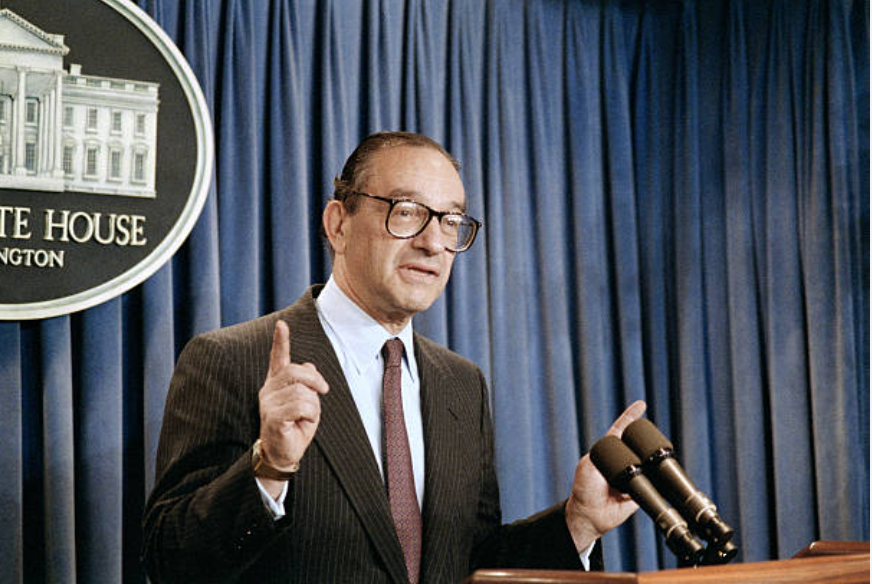
No one has influenced the development of today’s global financial system as much as Alan Greenspan. He presided over the Federal Reserve from 1987 to 2006, earning himself the title “Maestro,” or conductor, because of his ability to successfully navigate unprecedented levels of market instability, for example, the crash of Black Monday in 1987, the Asian financial crisis in 1998, and the explosive growth of information technology in the late 90s.
Economists and detractors alike continue to debate whether the cause of the credit crisis was connected to his policies or simply an unfortunate coincidence since it happened right after he left. Regardless, reviewing his time as a central banker provides a clear view into the evolution of our financial institutions. As the central banker for many years, Alan faced a tremendous and continuously changing challenge: How do you stimulate economic growth when there are vulnerabilities built into the economic system?
Navigating the Innovation Paradigm: The Greenspan Standard
Greenspan used a completely adaptable approach to manage the economy. He believed that managers of the economy should not be handcuffed by inflexible rules or formulas. He chose to pursue a highly flexible, risk management approach that relied on the use of huge amounts of real-time data to identify major economic shifts before they became apparent in inflation rates. This type of analysis allowed him to respond to changes in the economy much before the inflation numbers had become available. This was demonstrated in the mid-1990s.
Traditional economic theory held that an economy would be plagued with high inflation when unemployment fell to levels that were below previous historical standards. Thus, the standard practice to manage economic growth at those levels would have been to raise interest rates immediately. However, Greenspan observed that technological expertise was changing the shape of the U.S. economy. As productivity increased and production capacity rapidly expanded due to technological change, he placed more value on the information provided by his own experience and observations. When he kept interest rates low, the U.S. experienced one of the most prolonged periods of economic growth without high inflation on record (i.e., non-inflationary growth). This demonstrates that human flexibility is a far superior method for managing economies than rigid metrics, especially during times of large-scale technological disruption.
The Trade-off of Stabilization: The Crisis-Management Dilemma
The risk-reward trade-off of Greenspan’s legacy is predicated on the idea that while the Fed can provide short-run stability, it will ultimately lead to long-term risk. In other words, every time the economy is hit with major economic disruptions, such as a recession or a significant military conflict, the Federal Reserve would provide a rapid response by lowering interest rates and increasing liquidity to lessen the economic impact of the major disruptions. The result has been that many in the financial markets have dubbed the outcome of this type of monetary intervention the “Greenspan Put.”
The first significant test of the concept came on October 19, 1987, when the stock markets crashed on what has come to be known as “Black Monday.”
In response to the crash, the Federal Reserve flooded banks with liquidity to prevent a collapse of the economy. The intervention was successful and established a template for handling future crises and reinforced the Federal Reserve’s role as the ultimate lender of last resort. Unfortunately, the policy generated the second half of the Maestro’s dilemma. Many economists and academics have pointed out how the constant intervention by the central banks creates moral hazards for the financial markets. Studies have clearly shown that the implicit safety net provided by the Federal Reserve resulted in a decrease in the amount of risk taken by financial institutions. By virtually eliminating the downside of Wall Street, the Fed’s policy not only calmed the immediate panic but also privately encouraged financial institutions to take on excessive leverage in the future.
The Core of the Greenspan Legacy
Alan Greenspan’s career is essentially a perfect case study in an adaptive style of leadership. Studies on the Federal Reserve make it clear that institutions are required to adapt quickly to changing economic realities. His approach and leadership show that innovative organizations using creativity and a flexible, data-driven process can achieve significant historical successes. Central banks today are dealing with their main challenge: to find, most optimally, the balance between maximizing overall growth through the facilitation of inexpensive or more lax use of their monetary policies and the imposition of the strongest potential regulations necessary to most effectively secure the entire system.