
Review: First 100 Days of The Academic Boardroom



When we initiated the idea of The Academic Boardroom, what we sought to do was clear-cut—to link sound academic research to executive decision-making. In a communication world filled with short messages and auditory clutter, we envisioned that the corporate decision-makers were on the lookout for an academic library of a sort, a digital place that would provide them with practical ideas based on rigorous academic grounding.
Today is day 100 of The Academic Boardroom.
The vision of the platform has turned out to become a successful modern format in media. Having skipped various strategies suggested by others, the institution has developed a tremendous movement in international audio communication. Below is the assessment of our first 100 days based on a serious analysis of the results achieved, the technology of how the company operates, and the opening of the logical campus.
The Raw Data: Growth Velocity and Global Benchmarks
Typically, new independent podcasts have launched according to a known bell-shaped curve—a small first surge followed by a dramatic drop in listening before reaching a level of plateau. Data from Buzzsprout’s global statistics has shown us the average new podcast receives around 27 downloads in the first seven days after launch and that most independent podcasts never manage to surpass that number. Meanwhile, our performance has been completely opposite to that norm.
Macro Performance Milestones (as of July 31, 2026)
- Lifetime cumulative downloads: 22,400+
- July monthly consumption volume: 20,051 downloads, up from 1,879 in June — a 10.6x month-over-month surge
- Global footprint: Listeners established across 10+ countries, aligning with Edison Research’s Podcast Consumer 2025 documentation of executive-audience internationalization
- Production volume: 28+ published assets on a semi-weekly cadence
Cohort Lifecycle Multipliers (per episode drop)
To measure genuine audience retention rather than transient social traffic, we track episode performance across strictly defined post-publish windows:
- First 7 days: 46 downloads per drop (92 for dual-part guest features)
- First 30 days: 186 downloads per drop (372 for dual-part features)
- First 60 days: 395 downloads per drop (790 for dual-part features)
- First 90 days: 706 downloads per drop (1,412 for dual-part features)
Global Percentile Rankings
Comparing against the approximately 4.5 million podcast feeds and 605,122 podcast shows that are actively producing their content now, according to Listen Notes data as provided by Barrett Media, the following comparisons can be made:
- Top 1% worldwide (in the monthly average): Achieving at least 20,000 downloads on a monthly average position, The Academic Boardroom is within the top tier of the percentile bands, which have been established by Buzzsprout as those having an average of more than 4,600 downloads in the first week after dropping.
- Top 10% worldwide (in the period of 90 days): Getting an average of 706 downloads only for a single drop and 1,412 downloads from episodes in two drops establishes the show within the top 10% of the percentile bands that have been identified and defined in the data sets from Buzzsprout, Libsyn, and Rephonic.
- Top 35% worldwide (in the first 30 days): Accomplishing 186 downloads only in the first month places the level of performance of the podcast miles beyond the industry median noted by Descript, which is around 150 downloads.
- Top 40% worldwide (in the first week): Obtaining an average of 46 downloads per asset in the first week exceeds Buzzsprout’s median of 27 downloads by a considerable number of downloads.
- Category positioning in Goodpods: The show is constantly featured in the Goodpods ratings across the different categories related to academics, business leadership, and strategy.
Deconstructing the Inverted Growth Engine
What causes our platform to have a progress rate exceeding most independent launches found in the Rain News review of Buzzsprout platform data? Our structural publishing strategy provides the solution: the inverted evergreen loop.
The Dual-Drop Multiplier and Sonic Recaps
Instead of putting out a 60-minute program once weekly and losing audience interest, our different featured guests are presented in a multi-format framework dubbed the “Dual Drop”:
- Academic Foundations (written): A memorandum concentrating on research, the theoretical frames, and institutional data.
- Conversations with Application: Practical, real-world business applications, operational execution, and executive leadership insights.
- The 2-Minute Sonic Recap: Original custom-composed trap and thematic instrumental scores that musically encapsulate the week’s core thesis.
The idea behind the Dual-Drop format is that the feature allows for a variety of angles from which content can be voiced, thus facilitating maximum content exploration via the format.
The 15x Expansion Factor
According to the standard model found in The Podcast Host, roughly 80% of the downloads of a podcast happen within the first week. After this week, a podcast gets practically no more downloads. However, our data shows the opposite: our average podcast downloads start from 46 downloads in week one and reach 706 downloads at week 13. In other words, we are experiencing growth of 1,546%. More than 94% of our downloads now come from back-catalog material, and instead of being a disposable news feed, our platform serves as an everlasting digital library. Each newly published episode adds not only a few downloads but also attracts more people towards our historical archives.
High-Stakes Intellectual Capital: Editorial Quality and Guest Roster
Metrics are nothing but an expression of value. In our initial 100 days, we’ve engaged in profound and honest dialogues with leading thinkers, scholars, and professionals from domains including higher education leadership, digital preservation, knowledge building, and systems and equity strategies. The transcripts and audio files of our discussions are treated as an essential reference for industry leaders and scholars alike rather than simply promotional materials. Written articles and accompanying reports continue the discussion beyond the studio walls.
Transcending Audio: The Spatial Computing Campus
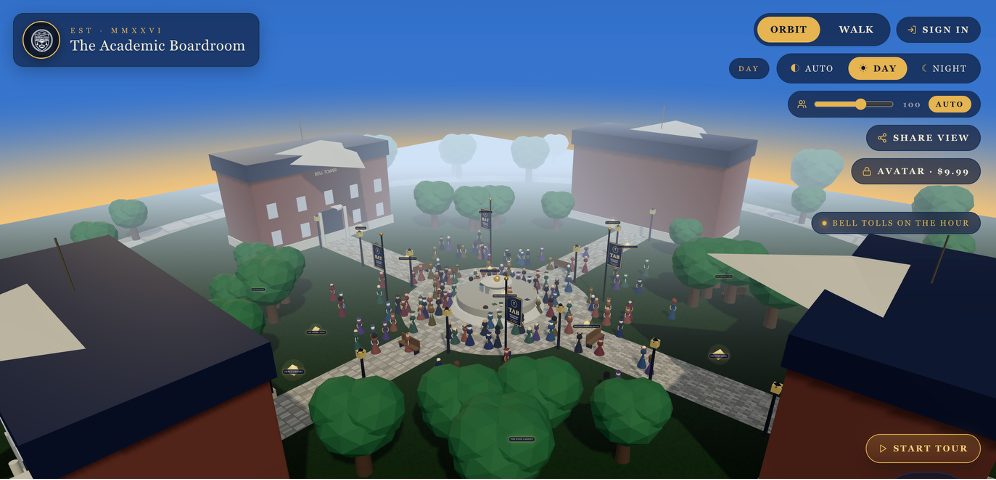
In the modern era, a B2B media brand must go beyond the traditional means of distribution. To completely revolutionize the way in which academic literature is practicalized, we have come up with our Spatial Computing Campus—an advanced metaverse space.
- The Lecture Halls and Auditoriums: Fire up virtual buildings equipped with Web3 and spatial technologies to enable listeners, scholars, and students to live stream podcasts and discussions in 3D open space.
- Interactive Research Labs: Special interactive venues created in space where technical documents, sports analytics algorithms, and organizational schemes elaborated in episodes are turned into 3D data visuals.
- The Executive Conference Room: Exclusive lounges where top business executives, university administration, and sponsors can interact without geographical barriers.
Commercial Validation: The Spatial Merch Store Quality Scorecard
The Spatial Computing Campus is much more than a platform for communication and networking. It’s largely defined by our digital space shop, which has branded clothes and products from the campus, along with future products from Spatial Bookstore. The shop earned third-party validation from Google’s commerce infrastructure in July 2026, with a score of “Good” on the Store Quality scorecard of Google Merchant Center in the category of the leading merchants in the United States.
The Google Merchant Center Scorecard is a proprietary measurement for shopping list quality used by Google and based on five mark ratings: Low, Fair, Good, Great, and Exceptional. The highest-rated stores get the honor of having the Top Quality Store badge in shopping surfaces. Rating is based on the level of accuracy of product data, clarity of shipping and returns policies, and checkout and post-purchase experiences. Getting the score of “Good” on the very first evaluation is a huge achievement for the shop that is taken into account in the history of the industry, since the category of the store is mostly taken by mature fashion and consumer goods retailers.
Now that there is information about the podcast being top-ranked in the Top 1% download percentile, along with the launch of the spatial campus program, we can say that the Merchant Center rating creates a unified picture of the ecosystem, where audio, real estate, and commerce have been validated by third-party benchmarks.
Strategic Expansion: Partnerships, Ecosystem Trust, and Monetization
In our outlook towards monetization, we aim to create long-term value through an ecosystem as opposed to just generating short-term ad revenue. We are implementing three collaborative initiatives that are based on utilizing leading-edge audience data gathered from Buzzsprout and Podtrac benchmark systems.
Strategic Brand Alignment and Listener Trust
Gaining respect from high-level scholars, business leaders, and practitioners requires a commitment to absolute editorial independence. Rather than using low-CPM programmatic ads, we work with brands using formats that create long-lasting impressions and relationships: co-created research with the institution or the sponsorships of executive summits conducted in and out of spatial computing campuses, as well as substantive integrations within educational narratives.
Monetizing Sonic Branding and Original Podcast Scores
Our unique sound design, including trap-style music, orchestral sounds, and other types of audiovisual cues, can also be classified as a commercially viable model. To better monetize this proprietary sound creation, we are producing original compositions for commercial use; we are releasing our own soundtracks on all major music platforms and using this original sound in the spatial computing arena to create unique sonic spaces.
The Spatial Computing Bookstore and Publisher Networks
Our list of guests consists of trusted experts, renowned academics, and leading enterprise innovators launching landmark publications. To take literary marketing to a higher level, we plan to form alliances with some of the biggest players in the publishing industry to set up a bookstore at our virtual university campus. The innovative store will feature stunning 3D images of titles by featured authors, along with audio clips of their reading excerpts from those titles.
The testing stage has been completed in the first 100 days. The next stage will bring the planned production to fruition.