
Spatial Computing Report: Is Higher Education a Pyramid Scheme?

Executive Abstract
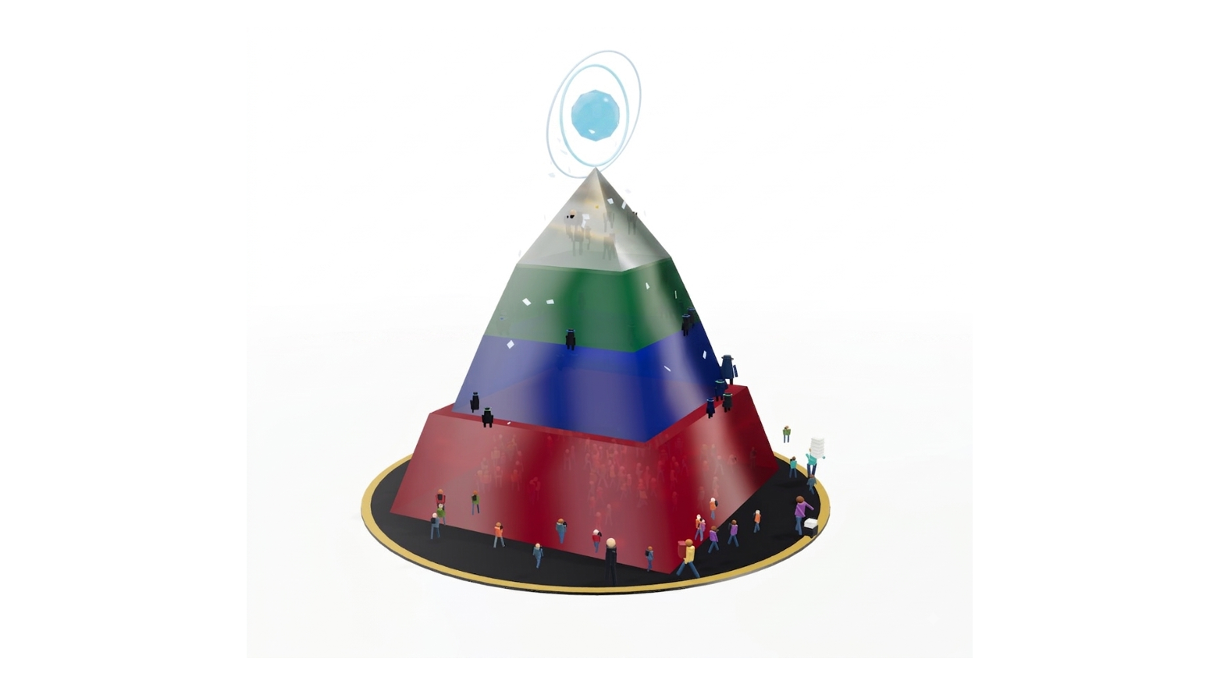
The essay puts forth a spatial computing simulation approach that envisions labor injustices in academia in terms of a virtual space rather than mere figures. The author sounds off against flattering expressions like “ivory tower” and, instead, comes up with a pyramid form, which reveals the core imbalance of academia—a huge, semi-transparent ruby-red base that stands for 68% of contingent faculty, adjunct poverty rates, and low remuneration per course—is a support for a small, privileged upper tier of sapphire and emerald elites and slow-working gold-quartz administrators. People are given some levers to manipulate the PhD production rate and budget limitations, thus bringing about a collective response, which works according to Peter Turchin’s elite overproduction theory: when the pressure is high, the “serf” population moves more quickly and chaotically, which demonstrates the pressure’s influence better than any paper figures ever would. The simulation features a “Publisher Vault,” which signifies how unpaid academic labor is drawn into the prestige economy. The most interesting aspect of the simulation is its “crisis mode,” when the environment suddenly becomes hostile and the conventional escape route is lost, which helps put the user in confrontation with the problem at hand. The essay asserts that the simulation creates a new standard of “spatial journalism” that truly means what it says.
Suggested Citation
Joseph, E. (2026). Spatial Computing Report: Is Higher Education a Pyramid Scheme? The Academic Boardroom, ISSN: 3143-9160. https://doi.org/10.68208/tab-spatial-computing-report-higher-education-pyramid-scheme
The Looming Crisis of the Base
For many years, the analysis of institutional injustice has been a matter of foresight. We have analyzed graphs, regression tables, and the thin blue lines tracing the fall of tenure. But one cannot step into a spreadsheet. A footnote cannot envelop one. Academic feudalism is the occasion of crossing a frontier—now we do not merely show the audience the data but invite it to live in it. This is more than just a visualization; it is a place.
The decision to depict the pyramid is deliberate; it presents an accurate representation of academic hierarchy seen through its ability to remain fixed. While every other metaphor about academia—ivory tower and scholarly community—seems to pay it unending compliments, it is the pyramid that represents an indisputable structural fact: a tiny fraction is being supported by an enormous number of people. People using the simulation immediately see not a set of statistics but a huge red ruby base, which is heavy and transparent enough to make all the upper levels look insignificant. The very large volume represents the AAUP data that 68% of professors work under temporary contracts, which means that they are not a marginal part of the academic structure but rather most of the academic workforce.
The reason why we chose the base to be rendered as a deep ruby-red stone is clear. Red represents the balance sheets of the workers: more than 25% of adjuncts earn less than the poverty level for a family of four, around 25% of them are dependent on government assistance, and the average income per course is around $3900 without the benefits. Nevertheless, we made the crystal translucent—a frosted glass—so that the eye could not help looking through the shells of the upper tiers and seeing the human mass that is trapped inside the underlying base. Prestige, in the institution, works hard to ensure that it hides its dependencies. The spatial computing allows for making the hidden layer literally visible within the stone, which is where everything else rests.
What is important, the base is not static. With the increase of the corresponding pressures on the institution, the base swells—it expands under the load in the same way as the pressure wall bends before collapsing. If someone wants to stand next to the building that is visibly stressed, they will be able to physically feel something that nobody could ever show with the help of a bar graph: the pyramid is not healthy; it is overloaded.
The Spatial Mechanics of Stress
A simulation differentiates itself from a still image by emulating a process; it modeled an aspect of academic feudalism, the process referred to as elite overproduction by Peter Turchin, which represents the Malthusian bottleneck of this scheme. Therefore, we created the bottleneck as an autonomous living structure instead of a scheme.
The space inside the ruby base is crowded with “serf” adjunct professors, teaching assistants, PhD students, and new graduates that are created using advanced technology so that they can move together as if there were just a single organism, always busy with something. They represent graduate students and adjuncts whose work provides the institution with its products. The visitor is given three levers to control: PhD production rate, budget constraints, and funding reduction. These levers do not just create some decorative effect; they are also directly related to what is called “community agitation.”
When you increase the PhD production rate and funding cuts, the number of crowd participants not only grows but also speeds up. The speed of the community runs faster and, after some time, their motion becomes chaotic: they start to move and change the previously chosen trajectories. This can be understood as the Malthusian concept of a bottleneck in action. The mathematical estimates show the extent of the problem: on average, the engineering instructor teaches around 7.8 students throughout his career but at the end of their work opens only one position; the ratio of the number of people with doctorates in humanities and the new hires is about 3.7 to 1; the number of PhD graduates in biology doubles in 20 years while the number of academic positions remains the same. These ratios can only be calculated, while in practice they represent the high level of pressure: more people are moving faster in the closed container.
Speed scaling does what no number can do. It conveys powerlessness. Here, the more product is produced by a base, the more time goes up, bringing no new level to absorb additional participants. A spectator sees the intensification in the process and realizes the entire scheme of recruitment: the whole system relies on hyperproducing lots at the very bottom. Movement is not a fault but the very source of movement. Giving an opportunity for a viewer to operate the process, we turn a conceptual theory into a practical example of real-time action.
Institutional Fiduciary Responsibility
Moving upward on the pyramid, the population dwindles while privilege becomes concentrated: the sapphire-and-emerald ranks of the privileged elite and, at its top, a clear quartz point sprinkled with gold, where some corporate-style administrators move slowly and without a hurry in contrast to the hustle and bustle below. The difference in speed is the story. Management has increased 60% to 146% since the 1990s, with the top 50 institutions employing three administrators for each professor, and yet at the very top, life moves at its own leisurely pace. Insulation has a movement signature, and spatial computing makes it easy to detect.
But what matters most, dominating the entire scene from above, is the Publisher Vault, a high-tech center hovering over the facility, continuously fed by the shining stream of data packets that rise from the laboring level and flow from there. The image visualizes workforce exploitation in its modern, computerized perspective—unpaid arbitration, ghostwriting, and manuscript production done by precarious laborers and appropriated by the so-called prestige economics. In written form, the asymmetrical value distribution represents an accused fact. Spatially speaking, it is a visible case regarding prestige and money accumulated by those who did not work.
Spatial computing makes fiduciary responsibility visible because it makes the flow identifiable. While in a salary table a wage cut is not seen, and the figures are in different boxes, when the same light-filled packet can be tracked from a commoner’s hand up through the levels that claim a part of it and finally into the vault, the question of who owes to whom ceases to be rhetorical.
The “Crisis” Shift
There is a point in the simulation that no essay of any type, including this one, can recreate. When you set the stress levels to collapse, the “Museum White” gallery that is neat, clean, and bright loses its brightness and becomes a pulsating and horrifying “Crisis Red.” The walls start to breathe. The light pulsates in unison with the vibrating base. Now you are not an outside observer looking at a crisis; you are in the middle of it.
This is the main reason to experience the crisis using a Vision Pro or Meta Quest instead of just reading about it. Reading is distanced: you only need to go to the page’s edge to find a way out. Being immersed takes away that distance. When the environment itself becomes hostile to you, the crisis is not a fact to be interpreted anymore; it is something you must live through (for a short time). Being there makes you sorry. When reading about the poverty among adjuncts, you are supposed to agree with the facts presented. When you stand inside the room that becomes reddened with the blood of thousands of professors struggling to survive in the golden place, you must listen to your conscience.
A Contemporary Standard for Immersive Journalism
The term “academic feudalism” does not describe one of the processes of investigation. Rather, it serves as the very investigation transformed to exist as a place where people can dwell. Up to now, there have been just like sixty Pulitzer Prize-winning writers in the world; they all experimented with moving social injustices from afar onto pages of books. Spatial journalism represents the next step of this writer’s craft; it aims to make the issue not only visible but also real for the audience. When the audience gets a chance of visiting the site and handle the social pressure themselves, then the issue is transformed from being simply observable into a practical experience.