
Spatial Computing Report: The Anatomy of the Blood Moon

Executive Summary
In this essay, we explore the reasons behind the reddish color of the moon during total and partial lunar eclipses. An eclipse is the alignment of the Earth, Moon, and Sun in a straight line, and lunar eclipses can occur only when the full moon is near the ecliptic. The shadow of the Earth has two parts: the dark umbra and the less dark penumbra, and it has been established that the eclipse can either be totally (in the umbra) or partial (in the penumbra). The red color of the moon does not come from the shadow but from sunlight filtered by Earth’s atmosphere. Some other factors also must be considered, like the presence of any aerosols in the atmosphere, measured according to the Danjon scale. In this essay, we look at the partial eclipse on August 27-28, 2026 (96.2% umbral immersion).
Finally, we move to the question of whether the phases of the moon can impact the health of human beings in terms of mood and sleep cycle. Skeptics, however, suggest that the arguments that support these views have been based solely on assumption, and there has not been adequate research done.
The Persistence of a Crimson Sky
Few cosmic events could create the same level of interest as a total lunar eclipse in the human consciousness. Even before scientists tried to come up with quantitative descriptions of the details of the event, people were interpreting the sudden reddening of an entirely illuminated moon as an omen of liberation, and this unriddled occurrence was perceived in cultures that shared nothing else. The thing uniting ancient astronomers and modern astrophysicists is not the interpretation of lunar phenomena but rather geometry as the reason behind the birth of fear in the past that has now just changed into an optical event that can be calculated precisely over tens of ages (Espenak & Meeus, 2009). The “blood moon” is a phrase that has not found its way into dictionaries of astronomy but is widely used in everyday discourse.
This paper analyzes the reasons behind this crimson color formation. It moves from orbital mechanics that make the eclipse possible, through the geometry of Earth’s shadow and the atmospheric optics that produce the color, then concentrating on the information about the particular lunar event—the partial eclipse on August 27–28, 2026—after which it raises the question the eclipse provokes: whether the light from the Moon has an effect not only on seeing but also on living. The reddening is not something characteristic of the Moon itself, and it is not arbitrary; it comes from the sunlight coming from the long journey through the whole atmosphere of the Earth before falling to the surface.
To analyze the phenomenon adequately, one must resist both the call for mystifying it and the tendency to dismiss it as “just” a shadow. Indeed, a lunar eclipse can be called a shadow, but it is not ordinary since its structure is interesting, and the radiance coming through it gives information about various aspects of the whole planetary atmosphere.
Orbital Mechanics and the Condition of Syzygy
A lunar eclipse can take place only when there is a strict geometrical requirement that the Sun, Earth, and Moon need to be aligned almost perfectly. This event is defined by astronomers as syzygy. This geometrical phenomenon, called “syzygy,” means that a full Moon must be observed. However, a full Moon happens once a month, whereas a lunar eclipse does not. The reason for such a discrepancy is that the Moon’s orbit is tilted by around 5.1 degrees with respect to the ecliptic (Espenak & Meeus, 2009). Due to this tilt, the Moon is at the maximum above or below the shadow of the Earth now, at the time of the full Moon.
Eclipses occur once the orbital plane of the Moon intersects the ecliptic plane near the nodes. The periodicity of full Moons at the nodes creates the seasons of the eclipses and the Saros cycle, equal to approximately 18 years and 11 days measured from the same node (Espenak & Meeus, 2009). Since these orbital revolution values are quite stable, the calculation of eclipses became one of the greatest achievements of astronomy when NASA counted every lunar eclipse in 5000 years. However, the syzygy condition does not take place now but rather is a constantly changing geometrical ratio.
The Architecture of Earth’s Shadow
The shadow of the Earth consists of 2 separate parts. It begins with the umbra shadow, which is dark in the center, and the penumbra shadow that surrounds the umbra shadow. The umbra shadow means that the light from the solar disk is fully blocked off by the Earth, while in the penumbra shadow, it is partially blocked off by the Earth.
The umbra is in the shape of a cone with its size determined by the diameters of the Sun and Earth and the distance between these two planets. The size of the umbra at the Moon’s distance determines how long the total eclipse lasts and how deep the Moon’s path through the shadow ends up being when we measure it with something called umbral magnitude, which tells us what part of the diameter of the Moon is in the umbral shadow at the closest point of the eclipse. If the number is less than 1.0, that means the eclipse is partial, whereas if it is 1.0 or higher than that, it means a total eclipse has happened.
Atmospheric Optics and the Genesis of the Red
The fact that the shadow shows how the Moon becomes dark doesn’t help us understand the question of why it becomes red rather than black. After all, if the full Moon is already in the umbra, it should become invisible. That it shines with coppery red light means that the atmosphere of any planet will act as a lens and filter.
The mechanism includes refraction and some scattering. When the light rays of the Sun touch the Earth’s horizon, they pass through the whole area of the atmosphere. It is along this long distance that the rays with shorter wavelengths disappear because of Rayleigh scattering. The observer on the Moon would see Earth surrounded by the light created by every sunrise and sunset happening now. The colors of red and orange will remain on the surface of the Moon. It has been proven by the spectroscopic study done during the lunar eclipse when it became clear that the transmission spectrum of the Earth in the case of the lunar eclipse shows that there is a visible Rayleigh continuum rising up and that the ozone Chappuis band colors the borders of the area dark blue (Pallé et al., 2009; García Muñoz et al., 2012).
The color and brightness depend on atmospheric aerosol. The volcanic aerosol can darken the eclipse and make it almost impossible to see the moon. To sum up the results, astronomers developed the Danjon scale, a system with its minimum mean number of L=0 (very dark) and maximum L=4 (bright copper-red), which should correspond to the stratospheric optical depth of aerosols (Danjon–SAOD analysis, 2023). In other words, it means that the color of the blood moon is not something unique; it helps to make atmospheric optical depth measurements.
Case Study: The Partial Eclipse of August 27–28, 2026
The partial lunar eclipse taking place on August 27-28, 2026, provides a useful example. In this case, we’ll have the maximum amount of immersion for the Moon at 96.2% in the umbra, which is extremely close to totality but not quite (NASA SVS, 2026; Sky & Telescope, 2026). Although most of the disk would be under the dark shade of the umbra, it would still leave some part of the Moon in penumbra, which means that it cannot be called a total eclipse.
This near approach is explained by the syzygy situation: the full Moon happens to be very close to an orbital node. The number has been obtained using a calculation procedure that allowed the value to be given with an accuracy of a tenth of a percent. Moreover, the full immersion would also mean that Earth will use its atmosphere to create a red color for the lunar disk immersed 96%, while the remaining sliver will be white. Whether the color of the eclipse will be more like copper or something going to brown depends on the aerosol conditions. Thus, we consider all previous points of the analysis.
Future Directions: Making the Vectors Navigable
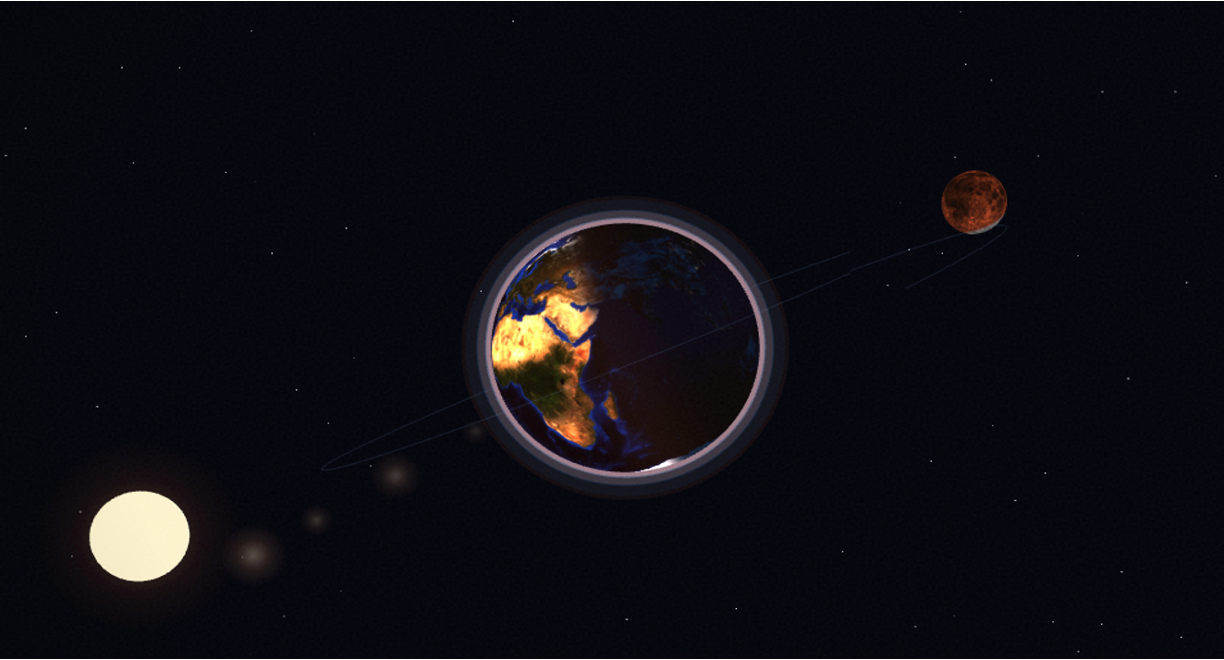
Having traced the mechanics of the umbral passage, one essential question remains: how can we perceive the vectors that dictate it? The geometry of a total lunar eclipse is a fundamentally spatial phenomenon, and a static diagram flattens exactly those three-dimensional relationships that create it. Interactive 3D visualization provides the next logical step.
The very crux of the geometry is formed by the umbral cone. On August 27-28 during the partial eclipse, the Moon crosses to a calculated umbral depth of 96.2%, grazing the darkest part of the Earth’s shadow, though not getting fully immersed. As the colors making up the “blood moon” are not inherent to the phenomenon but the product of physical phenomena, sunlight reaching the edge of Earth suffers Rayleigh scattering, which bends all the remaining copper-red light towards the umbra. How deep that redness is depends on shadow cone geometry in syzygy and the level of atmospheric aerosol loading, which is the main factor causing volumetric darkness on the Danjon scale.
These are the parameters where the interactive layer becomes useful. Our spatial computing demonstration makes use of the above-mentioned geometry as a usable instrument. Users can navigate the syzygy by manipulating time and rotating the umbral and penumbral cones to see the alignment from any point of view. The Danjon scale dial operates in real-time and allows users to see how aerosol loading changes the expected red shift, while a jump-to-alignment feature directly brings about the peak of August 27-28. Of utmost importance is that the shadow cone geometry modeled in the presentation is supported by NASA’s Five Millennium Canon of Lunar Eclipses, making sure that the simulated umbral taper and contact times truly correspond to astronomy parameters that are verified by other observations—thus, the 4-D application represents a complementary observation and explanation tool over the review-based geometry.
When seen in this way, the immersive demonstration expands our knowledge instead of replacing it. This is the gain promised by interactive astrophysics: no fireworks, but a strong connection between rigorous geometry and people’s cognition.
The Moon Beyond the Shadow: Lunar Rhythms in Human Biology
An eclipse is one aspect of a sudden alteration of the light produced by the moon—an incredible loss of intensity and change in color of the most illuminated body of the night sky. This fact creates a question, closely connected with optics but distinct from that: if the brightness of the moon shows a regular pattern during the month of its cycle, does this pattern influence human physiology? The idea has historical roots in cultures from ancient times and is widely criticized scientifically, so the matter is rather ambivalent (Foster & Roenneberg, 2008).
The skeptical stance is well-expressed. In reviewing literature, Foster and Roenneberg concluded that, despite widespread acceptance of the idea, there is no substantial proof that the lunar cycle affects humans. This caution is required as a method since those studies devoted to finding the lunar influence on humans are subject to the so-called “file drawer problem,” implying that positive results are published without introducing negative results and therefore misrepresenting the influence strength on humanity (Cordi et al., 2014).
In this context, the results of two recent studies cannot be ignored. In a well-controlled laboratory environment, participants and researchers did not know what lunar phase it was—Cajochen and other scientists made an interesting discovery: during the full moon, activity of people’s deep sleep, according to the EEG measurement, dropped by about 30%, and sleep was shortened by about 20 minutes. The authors reached the conclusion that the absence of external environmental signals suggests an endogenous circalunar effect.
Correspondingly, a wider community experiment with the help of wrist actigraphy, which involved several populations starting with rural natives who do not use electricity and ending with urban students, revealed that for everyone sleep began later and lasted shorter right before the full moon, with the number of total sleep durations varying by 46–58 minutes during the lunar month (Casiraghi et al., 2021). In this regard, the effect was the most vivid among the communities with the least electric light, thus supporting the idea that this can be a remnant of our adaptation to utilize the moonlight for early-night activities (UW News, 2021; Yale News, 2021).
There are two reservations preventing us from overextending the results. Firstly, the explanation is debatable because the effect was still discovered with urban populations that were not aware of the lunar phase, which made the authors realize that there might be non-photic factors, although light itself has become the leading candidate for explaining the results.
Secondly, this phenomenon cannot be examined without considering the research within the field of chronobiology, where the main zeitgeber is the contrast of natural illumination, as a result of two experiments when Wright and his colleagues moved subjects from electric light to camping for one week and made them realize that their circadian cycles changed by two hours (Wright et al., 2013). And regarding the implications of this in the wider ecological literature, we see the described pattern as not so profound as it suggests.
The fact that this question concerns people is very indicative since the 2021 study has appeared in the center of media attention. This happens because of the same interest that urges people to admire a blood moon. The two phenomena deal with the same thing—the light brought to the Earth by the Moon. The former examines how this light affects our perception, while the latter studies its influence on our physiology. Neither goes too far away from what the results demonstrate, and it is this limitation that makes the research scientific rather than mystical.